What is Enlightenment? (And Why It’s Not What You Think)
What is Enlightenment? (And Why It’s Not What You Think)
The word "enlightenment" carries a heavy load of cultural baggage. When we hear it, our minds immediately jump to stereotypes: glowing auras, levitating gurus, and a permanent state of unbroken, blissful ecstasy. We are sold the idea that enlightenment is a superhuman state, a magical destination reserved for a chosen few who meditate in caves for decades.
But if we strip away the mystical fluff and look at the actual mechanics of consciousness, enlightenment is much closer, much simpler, and far more grounded than we are led to believe.
So, what is enlightenment really?
It Is Not Gaining Something; It Is Losing Something
The biggest misconception about enlightenment is that it is an acquisition. We think we need to gain more knowledge, gain better karma, or gain a higher frequency.
In reality, enlightenment is a process of subtraction. It is the realization that the "you" who is trying to become enlightened is actually the obstacle. From a neuroscientific and mindfulness perspective, our brains are wired to run a constant, self-referential narrative—the ego. We spend our lives identifying completely with this voice in our heads.
Enlightenment is simply the moment that illusion collapses. You do not become a new, better person. Instead, you realize that the person you thought you were was just a bundle of conditioned thoughts, memories, and societal programming. When that heavy baggage is dropped, what remains is your true, undisturbed nature.
The Reality of Nonduality
To understand enlightenment, you have to understand nonduality. The word itself means "not two."
Right now, you likely experience the world as a subject moving through a universe of objects. There is "you" in here, looking out at "the world" out there. Enlightenment is the experiential realization that this separation is a complete illusion.
When the rigid boundaries of the ego thin out, you recognize that the silent awareness looking out through your eyes is the exact same consciousness animating everything else. The gap between the observer and the observed closes. You do not just feel connected to the universe; you realize you are it.
The Ascent, Not the Destination
It can be helpful to view the path to enlightenment not as a single, sudden lightning strike, but as an ascent up a profound spiritual mountain. As you climb higher, the air gets thinner, and you can no longer carry the heavy, dense beliefs of your past.
With each step, you are actively rewiring your brain. You are training your nervous system to step out of the chronic stress of egoic survival and rest in the spaciousness of the present moment. The view expands, the noise of the mind settles, and you begin to live from a place of profound clarity.
But make no mistake: reaching the "summit" does not mean you stop being human. You will still get flat tires, you will still feel physical pain, and you will still have to pay your taxes. The difference is that you no longer suffer over these things, because there is no longer a rigid "ego" for them to stick to. You experience reality exactly as it is, without the resistance of wishing it were different.
How to Begin the Climb
Enlightenment is not a concept to simply be understood intellectually; it is a reality to be lived. Reading about it is like reading a menu when you are starving—eventually, you have to eat.
If you are tired of merely reading the menu and want practical, grounded mechanics to experience this shift in awareness for yourself, the journey begins by looking inward. You can start exploring these principles directly with a

The Know Thyself Course Free Trial
Join our mailing list to receive your free trial, free books and the latest news and updates from author / teacher J. Stewart Dixon
Recent Posts
Author

J. Stewart Dixon
Author / Philosopher / Iguana Owner
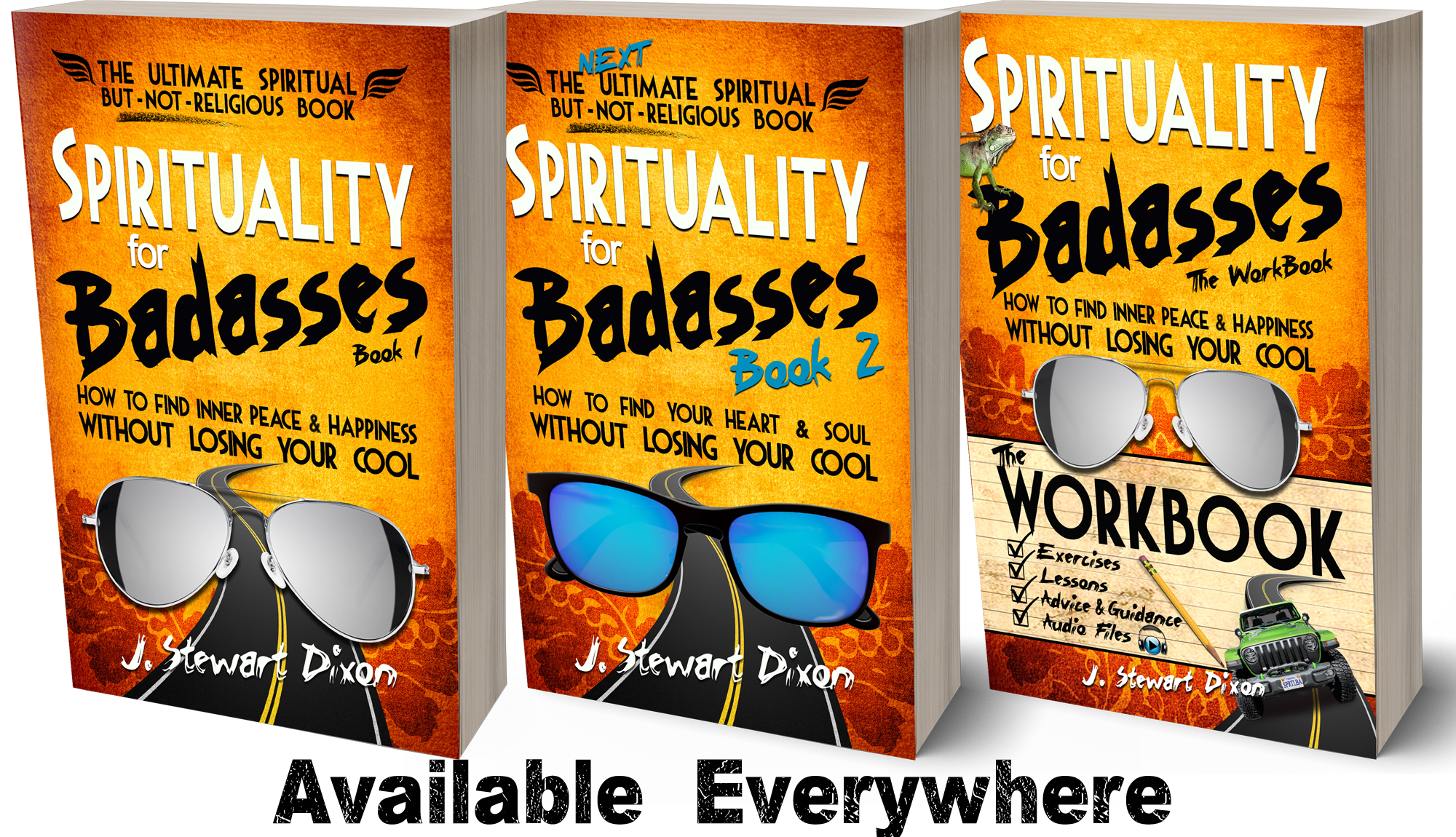
J. Stewart Dixon is an unorthodox, know-thyself, personal-growth teacher and multi-award winning, best-selling author best known for his Spirituality for Badasses book series. He teaches based on thirty years of training, interaction, growth and insight with a wide variety of modern Zen and Nondual teachers, his ongoing education and certification in neuroscientific mindfulness and a degree in communications from Syracuse University.